Wednesday, 27 February 2013

Playing to Death's tune

Music was heard in many of the concentration camps and ghettos throughout Nazi Europe. It was used as a symbol of comradeship amongst the Jews throughout the extreme poverty, depression and the death that surrounded them. Ghetto songs could be used as a diversion from reality and to keep traditions going.

Though songs from before the war were still sung, life in the ghettos and concentration camps led to new songs usually with no accompaniment. Many Jewish musicians had sold their instruments for money or food in and before they were moved to the ghettos and many instruments had been stolen by the Germans. These songs were often inspired by the latest gossip and news. However some of the songs were personal experiences that often included the death of friends or family or of their treatment by the Germans.

However, some instruments were played in the ghettos. Though not as common, classical music and instrumental work was also composed and performed in some ghettos and labour camps.  For many of the Nazi victims, music was an important means of preserving their humanity. This music is a form of audio historical documentation telling of the emotions and events that their authors experienced.

Street songs were a style of  ghetto music, emphasising four dominant themes: hunger, corrupt administration, hope for freedom, and a call for revolt. A majority of ghetto street songs were sung to preexisting melodies, a technique known as contra fact. Contra fact became necessary because composers couldn't generate new music fast enough for all of the lyrics being written.
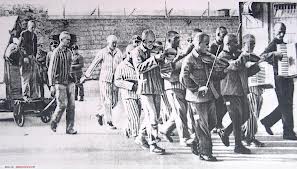
At some of the death camps the Nazis created orchestras of prisoner musicians, making them play while their fellow prisoners marched to the gas chambers. Many musicians were forced to watch as their friends and families walked past them to their death. Auschwitz alone had six orchestras, one orchestra was thought to contain 100-120 musicians.

Resistance songs:
Out of all the songs sung in the ghetto the song of the Partisans by Hirsh Glik was the one that spread like wildfire. "Zog nit keynmol az du geyst dem letstn vet" ("Never Say that You Are Trodding the Final Path"). This song became one of the official resistance hymns of the Eastern European partisan  brigades. It was translated into Hebrew, Polish, Russian, Spanish, Romanian, Dutch, and English. It was a well known song in many of the concentration camps.
One member of an Auschwitz woman's orchestra was named Fania Fenelon. In her book 'Playing for time' she describes that though she had clean clothes and daily showers, she was made to play "gay, light music and marching music for hours on end while our eyes witnessed the marching of thousands of people to the gas chambers and ovens."
 
Sources:
fcit.usf.edu/holocaust/arts/MUSVICTI.htm
Picture-Mauthausen Concentration Camp orchestra

Sunday, 24 February 2013

Safe houses


The Secret Annexe used by the Frank and
Van Pels families along with Fritz Pfeffer
These were houses that people were hidden in when they were trying to escape persecution. Normally they were taken there by someone else who then brought food and other necessary items like; blankets, warm clothing and news from the outside world. If you lived in a safe house then you, normally, had to be very quiet and you couldn't go outside for fear of recognition. If you were hiding in an enemy area and your neighbours realised you were there then they would often call the enemy troops who would then either kill or arrest you.
Some houses were only temporary; somewhere for the refugees to stop for the night on their way out of the country, others were more permanent but they sometimes changed due to the position of enemy forces and conditions.
Food was often in short supply and there was always a risk that you would be discovered. When that happened people would either give themselves up or sometimes, commit suicide. This meant that the enemy wouldn't be able to subject them to torture or gain any information from them.

Link: http://www.historyplace.com/worldwar2/holocaust/timeline.html#top

Sources: http://www.annefrankguide.com/en-gb/content/achterhuis.jpg

Saturday, 23 February 2013

The Seven Dwarfs of Auschwitz

When the Ovitz family arrived at Auschwitz, the SS Guards were astounded. Seven people were lifted off the train one by one, five were women, not much taller than a girl of 5, yet they wore elegant dresses and make-up which made them look like painted dolls. They huddled in a circle where they made no attempt to join the other passengers being rounded up. Instead, one of them started handing out autograph cards for they were the famed Lilliput Troupe known for their variety shows.

Like most of the Hungarian Jews, they had been on the train which took 3 days to arrive at Auschwitz-Birkenau, but the dwarfs had no idea that they had just been deposited in the Nazi's most notorious extermination camp.

One of the SS officers went over and established that they were all siblings from the Ovitz family. Immediately, he gave the order to call Dr Mengele: "Wake the doctor!"

It was nearly midnight on Friday, May 19, 1944, and Dr Josef Mengele was asleep in his quarters. All the troopers on duty, however, were well aware of his passion for collecting human ‘freaks’, including hermaphrodites and giants.
Meanwhile, the dwarfs watched the rest of the passengers — including their aunts, uncles, cousins and friends — march towards a building with two chimneys that ceaselessly poured out smoke and flames.

Perla recounted many decades later;
 
"each flame looked like a human being, flying up and dissolving in the air. We went numb, then started thinking about the unknown man we were waiting for — if this was a graveyard, then what was a doctor doing here?"

Mengele whispered orders to the officer in charge. Remarkably, not only were the seven dwarfs, their two normal-sized sisters, sister-in-law and two of their children saved from the gas chamber that night, but so were the families of their handyman and neighbour — who insisted they were close relatives.
Only three hours had passed since the arrival of their train and most of the passengers — 3,100 out of 3,500 — were already dead. The dwarfs were lifted on to a truck and driven away.

Like all the other prisoners, they lived in a barrack and ate the same watery soup, but it was clear that they’d been set apart.
Instead of having to use the latrines, they were given the potties of dead babies. There was also an aluminium bowl in which they had to wash every day, as Mengele was obsessed with hygiene. On the day they were summoned to Mengele’s lab, the women carefully made up their faces and put on their best dresses. To the emaciated inmates who saw them led to a truck, they must have seemed like a bizarre hallucination. The lab looked like any ordinary clinic, with staff in white coats. All they seemed to want at first was to take blood samples, which seemed a small price to pay for their lives.  But the blood-letting was repeated week after week, along with dozens of X-rays. "The amount of blood they took was enormous and, being feeble from hunger, we often fainted" recalled Perla. "That didn’t stop Mengele: he had us lie down and when we came to our senses they resumed syphoning our blood."
"They punctured us carelessly and blood spurted. We often felt nauseous and vomited a lot. When we returned to the barrack, we’d slump on the wooden bunks — but before we had time to recover, we’d be summoned for a new cycle."


Over a long period of time, the family were tested, experimented on and studied. In 1949, after their horrific adventure and the liberation of the camp, the family emigrated to Israel, where they spent several years touring with their stage show until ill health forced them to retire. By the time Perla told her incredible story of The Seven Dwarfs of Auschwitz, the rest of her family had died.

Mengele, who had escaped justice by fleeing to South America,  is believed to have drowned in 1979. Had he been caught, Perla said she doubted he would have apologised for what he did to her family.

"But if the judges had asked me if he should be hanged, I’d have told them to let him go."

"I was saved by the grace of the devil — God will give Mengele his due."
Perla died peacefully, aged 80, on September 9, 2001.

Sources:

The Ovitz family on their arrival


Fight to the death; the Rwandan, Serbian and Nazi genocides

Similarities:

  • They all focused on one group of people and made them scapegoats for all of the countries problems.
  • The persecutors saw themselves as the victims of previous injustices at the hands of the group they were now targeting: Nazis blaming Jews for the 'stab in the back' of 1918; Serbians blaming Muslims for the destruction of the medieval Serb kingdom; Hutus blaming Tutsis raised above them by colonial rulers.
  • The victims were displayed as sub or even non human.
  • There was a lot of propaganda and media involved.
  • Nazi flag

Rwandan refugee camp

Differences:

  • The Rwandan genocide was much quicker than the others. 8000 people were killed on average every day.
  • Rwanda didn't create camps for people to be held in.
  • Rwanda used machetes to hack people to death whereas in the other genocides shooting was the main method.
  • The Nazi's were the only ones to use gas chambers.
  • In Serbia and Rwanda there were UN troops overseeing and trying to keep peace.

A memorial to the victims of the Serbian genocide
Srebrenica was the biggest massacre in Europe since the end of the second World War. The town was declared safe by the UN so a lot of Muslims settled there  to avoid being persecuted by the Serbians . The town was being watched by some Dutch troops to keep the peace, but when the Serbian forces started to approach they had to make a choice: they could either stand their ground and die trying to save people that would be killed anyway or they could oversee people getting onto the buses and try to decrease the level of brutality used. The chose the latter. When the Serbian forces stormed the town they loaded the women, children, old men and the Dutch troops onto to buses and drove them away. They then put all of the boys over the age of ten or eleven and all of the men under sixty onto different buses. They were then taken into the woods and shot. About 7000 boys and men were killed.

http://news.bbc.co.uk/1/hi/programmes/panorama/3582139.stm
http://www.bbc.co.uk/news/world-africa-13431486
Source - Professor J. C. Williams

Dr Mengele; man or monster?

 Dr Josef Rudolf Mengele  was a German SS officer and a physician in the Nazi concentration camp of Auschwitz. Dr Mengele was one of the SS physicians who were in charge of the selection of arriving transports of prisoners, determining who was to be killed and who was to go into forced labour. However, Mengele is most infamous for his experiments on the inmates of the camp, including children, especially twins. On one day alone he killed fourteen twins. For this and much more Mengele became known as the 'Angel of Death'.

It is claimed he once drew a line on the wall of the children's section 150cm (about 5 ft) from the floor and decided that any children whose heads did not reach the line were sent straight to the gas chambers.

Dr Josef R. Mengele
He was particularly interested in identical twins and took a special interest in the camp inmates who were considered to have physical abnormalities. These included dwarfs, most notably the Ovitz family- seven of whom had dwarfism.

Mengele's experiments were  horrific . During 1943 Mengele performed certain experiments on female prisoners using shock treatments and sterilisation. Most of Mengele's victims died, either during the experiments or later as a result of infection.

Though the  people used for  Mengele's research were better fed and housed than other inmates, many of his experiments resulted in more painful deaths.When he visited the children on whom he conducted his experiments, he was known to call himself  "Uncle Mengele" and offer them sweets.

An Auschwitz prisoner doctor once said:
"He was capable of being so kind to the children, to have them become fond of him, to bring them sugar, to think of small details in their daily lives, and to do things we would genuinely admire.... And then, next to that,... the crematoria smoke, and these children, tomorrow or in a half-hour, he is going to send them there. Well, that is where the anomaly lay."
Source: en.wikipedia.org/wiki/Josef_Mengele
Link: http://www.youtube.com/watch?feature=player_embedded&v=gG2QaN_LUao


The Art of Auschwitz

During the mass killing in Auschwitz, inmates who produced clandestine artwork did so while risking their lives. The artists used their paintings to express their own humanity. Some inmate art was sanctioned by the camp or ghetto authorities. Nazi officials used talented artists to produce personal items for them. The picture above shows inmate David Olère adding flowered decorations to a letter for an SS officer.

The art was drawn by adults and children alike. Most were discovered at the liberation of the camp which found hundreds of pieces of artwork. Conditions in some German internment camps actually allowed artists freedom to continue working. Joseph Nassy, a black artist of Jewish descent, was able to produce more than 200 drawings and paintings during his three-year internment at Laufen and Tittmoning camps in Bavaria.

Lots of the art was drawn in secret, usually in washrooms or on ceilings. There aren't many  examples of this art, but there are a few here:

Sources:
http://fcit.usf.edu/holocaust/resource/gallery/FWALL.htm
http://archiegirl28.tripod.com/id6.html

Interactive map of Auschwitz:
http://www.bbc.co.uk/history/interactive/animations/auschwitz_map/index_embed.shtml


Painting of the 'King's canal' on a ceiling. Painter unknown.


Camels and pyramids. Painting from block 14
in Auschwitz


Cherubs. Washroom in Auschwitz
block 7.
Horse back riders from the same washroom as
cherubs. 

Finding Anne Frank

The Frank family prepared to go into hiding in 1941. With the help of his staff (Victor Kugler, Jo Kleiman, Miep Gies and Bep Voskuijl), Otto could prepare the secret place in the two upper back floors of the building that his firm occupied. He did this for his own family and that of Hermann van Pels, another employee.

Margot Frank recieves the call to report to a 'labour camp' on the 5th July 1942. The Franks then move into the Secret Annexe, which was concealed behind a moveable bookcase, the following day. The address is 263 Prisengracht. A week later Mr and Mrs van Pels and Peter, their son, arrived. In November they were joined by Fritz Pfeffer who was a dentist.

Anne Frank

Anne Frank wrote in her diary, that was given to her for her 13th birthday by her father, about the experiences of everyday life in hiding. After she hears a radio broadcast saying that any letters and diaries about life under German occupation might be published when the war ended she decided to to edit her diary. She changed the names of her 'characters' and made it more like a novel.

On the 4th August 1044 the Secret Annexe was raided by SS Sargeant Karl Josef Silberbauer with some Dutch Nazi's. Everyone was arrested, then sent to Westerbork transit camp and then on the final train to Aushwitz. They left on the 3rd September 1944.
The helpers: Jo Kleiman, Miep Gies, Bep Voskuijl and Victor Kugler (left to right)

Only Otto Frank survived through the camps out of all the people who went to the Annexe. He was freed by Russian troops in January 1945. Mr van Pels died in the gas chambers of Auschwitz in November or October of 1944. Edith Frank died of exhaustion and hunger in Auschwitz on the 6th January 1945. When the Russian army approached Auschwitz was abandoned and Peter van Pels was sent to Mauthausen camp in Austria. He died on the 5th May 1945. Fritz Pfeffer died in Neneungamme concentration camp on the 20th December 1944.

The eight people that lived in the Secret Annexe
Margot and Anne Frank were taken back to Germany at the end of October 1944. They were transported tpo disease-ridden Bergen-Belson. They both contracted typhoid and died in March 1945. The camp was liberateed a few weeks later in April 1945. Mrs van Pels was also moved to Bergen-Belsoon and from there she went to Theresienstadt, where she died in April 1945.

The World of Anne Frank, compiled by the Anne Frank House